

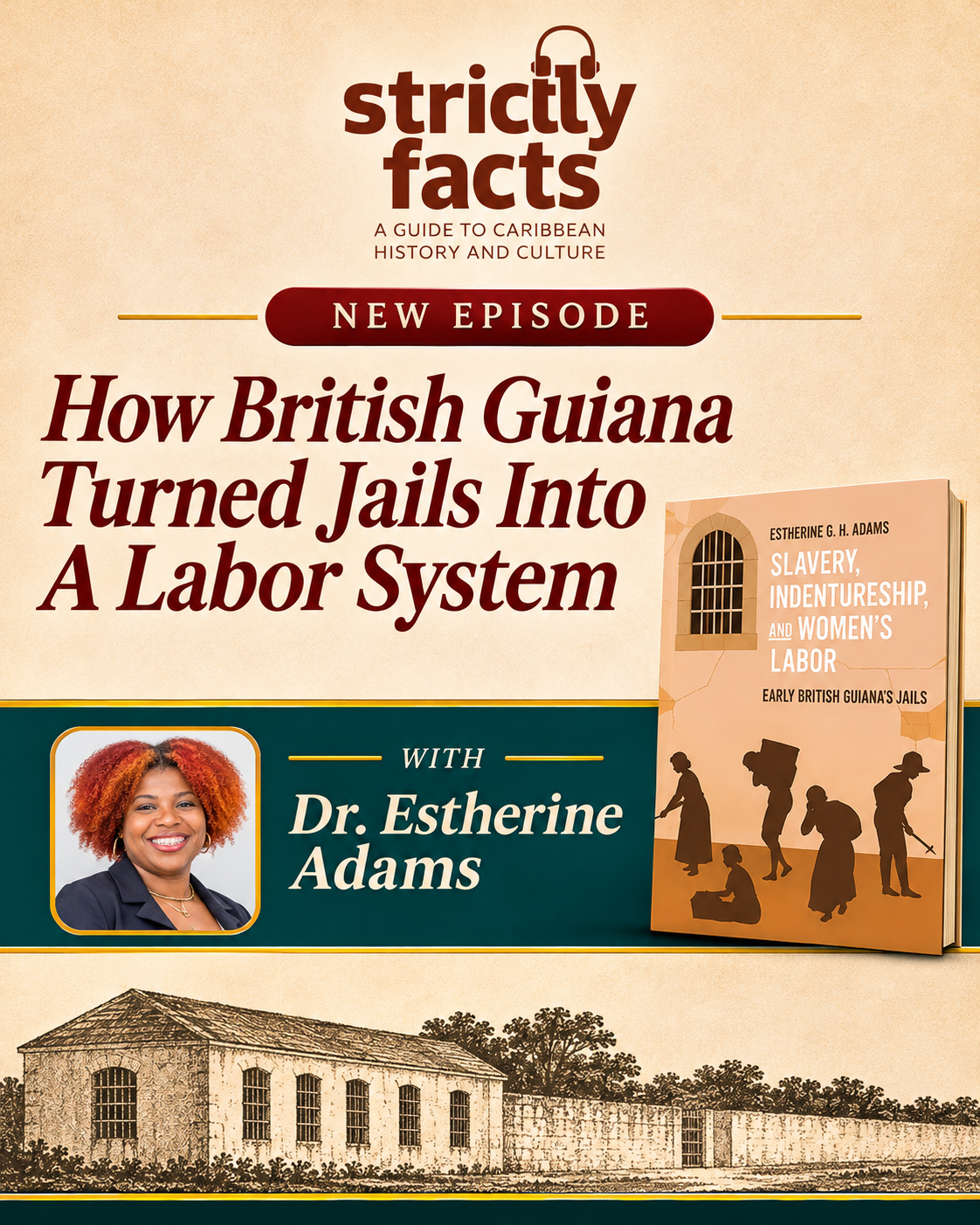
In today's episode, we go to British Guiana, now Guyana, to follow a hard truth after emancipation: when plantation owners and colonial officials lost legal ownership of people, they often rebuilt power by redesigning labor itself, and the prison becomes one of their sharpest tools. Dr. Estherine Adams, head of the Department of History and Caribbean Studies at the University of Guyana, joins us to unpack research from her forthcoming book Slavery, Indentureship, and Women’s Labor: Early British Guiana’s Jails. We talk about how colonial rule shifted from Dutch to British structures, and how, after 1838, autonomy for formerly enslaved people collided with a colonial economy that demanded a “consistent labor force.” Indentureship flooded the labor market, wages fell, and new ordinances turned everyday acts, like leaving a plantation without a pass, into criminal charges.
The most unsettling part is what happened next: incarcerated labor was monetized. Plantation owners bought labor from jail authorities for less than free wages, while the colony used prison labor for roads, institutions, and massive seawall construction. Centering incarcerated women changes the story again, showing women working outdoor hard labor alongside men, facing gendered punishments like haircutting, and resisting a system that tried to make them legible as disposable workers. We close with the long arc from colonial carcerality to today’s prison industrial complex and the persistent logic of “forfeited” labor. Share this conversation with someone who thinks emancipation was a clean break, and leave a review if it reshaped how you think about freedom, labor, and incarceration.
Dr. Estherine Adams is a University of Guyana History and Caribbean Studies lecturer and the Director of the International Centre of Excellence for History, Identities, Populations and Temporalities. Her research interests’ centers on 18th- and 19th-century Atlantic World, contemporary British Guiana politics, the British Colonial Caribbean, and the prisons in British Guiana the with an emphasis on women and gender. She has published several articles and has worked on several projects including the Leicester University project ‘History of the Georgetown Jail’ and the British Academy grant project ‘History and Security Sector Reform.” Her manuscript, “The Few Among the Many: Women’s Labour in British Guiana’s Jail, 1838-1917” won the 2023 Guyana Prize for literature nonfiction award. She is currently under contract for the publication of her forthcoming book (October 2026) Slavery, Indentureship and Women’s Labour, Early British Guiana’s Jails with the University Press of Mississippi. She is also the winner of 2025 Edna Ryan Prize for the best article in Women’s History, awarded by the Australian Society for the Study of Labour History.
View the Strictly Facts Syllabus for more resources on this episode.